
Who Is Behind the Church Shooting in Jordan?
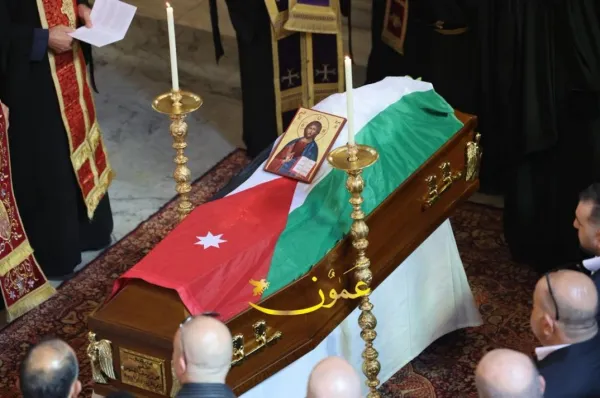
The funeral procession for Dr. Mohammad Qassous, known as the “Doctor of the Poor,” began on Monday afternoon. He was killed when gunmen opened fire during a funeral procession at a church in Hamoud, in Jordan’s Karak Governorate, on Friday. Photo credit: Ammon News
On October 23, gunmen opened fire during a funeral at St. George’s Greek Orthodox Church in the village of Hamoud, in Jordan’s Karak governorate. Nine people were killed and 34 wounded. The attack shocked a country where Muslims and Christians have long lived together.
Jordanian authorities arrested three suspects after a shootout in the nearby village of Al-Jadeeda. According to reports, the suspects belong to one family. Authorities have not publicly established their affiliation with any larger organization, and no group has claimed responsibility.
The investigation must establish who carried out this horrific attack, why they did it, and whether anyone else was involved. Until then, speculation should not replace evidence.
The funeral was for Dr. Mohammad Qassous, known as the “Doctor of the Poor.” His death and the killing of other mourners represent a tragedy for their families and the entire community.
In Jordan and elsewhere in the Arab world, Christian and Muslim families often give their children Arabic names that are shared across religious traditions. Muslims, for example, name their children Issa (Jesus), Maryam (Mary), and Musa (Moses). These shared names reflect a long-standing cultural and historical tradition. A person’s name or religious background should never be used to cast suspicion on an entire community.
Yet some social media users were quick to blame Islam and mock Muslims by calling it the “religion of peace.” Why is an entire faith held responsible for the actions of individuals, while other religious communities are not routinely subjected to the same collective blame?
Where is the same scrutiny when discussing the Israeli genocide in Gaza and settlers' terrorism in the occupied West Bank? Criticism should focus on the people, institutions, and governments responsible—not on an entire religion or people.
The same principle must apply to military actions by governments. Three days after the church attack, Jordan launched airstrikes against sites in Syria’s Daraa and Sweidaa provinces, saying it was targeting Islamic State militants linked to threats against Jordan.
Syrian authorities reported that the strikes killed seven civilians, including three children and a woman, and wounded three others. Five of the dead belonged to one family. Jordan expressed regret over the civilian casualties and said it had sought to avoid civilian targets. The two governments have agreed to establish a joint security committee to examine the operation.
Those civilian deaths must not be overlooked simply because the weapons came from a military aircraft rather than a gunman.
When was the last time Christianity itself was put on trial for U.S. military war crimes and bombing in Lebanon, Iran, Syria, Iraq, Afghanistan, Yemen, Somalia, or Venezuela? Governments and militaries should be held accountable for their actions without blaming all Christians, just as Muslims should not be blamed collectively for violence committed in Islam’s name.
Terrorism has no nationality, ethnicity, or religion. My heart goes out to all the victims and their loved ones—in Jordan and Syria alike. Their lives matter, and their families deserve justice, truth, and accountability.
Mahmoud El-Yousseph is a Palestinian freelance writer and retired U.S. Air Force veteran. He writes about U.S. foreign policy, Middle Eastern affairs, and justice.
Photo caption: Syrian media outlets have published images of victims of Jordanian airstrikes in the Daraa countryside on the evening of October 27, 2026. Photo credit: Bintjbeil.org